

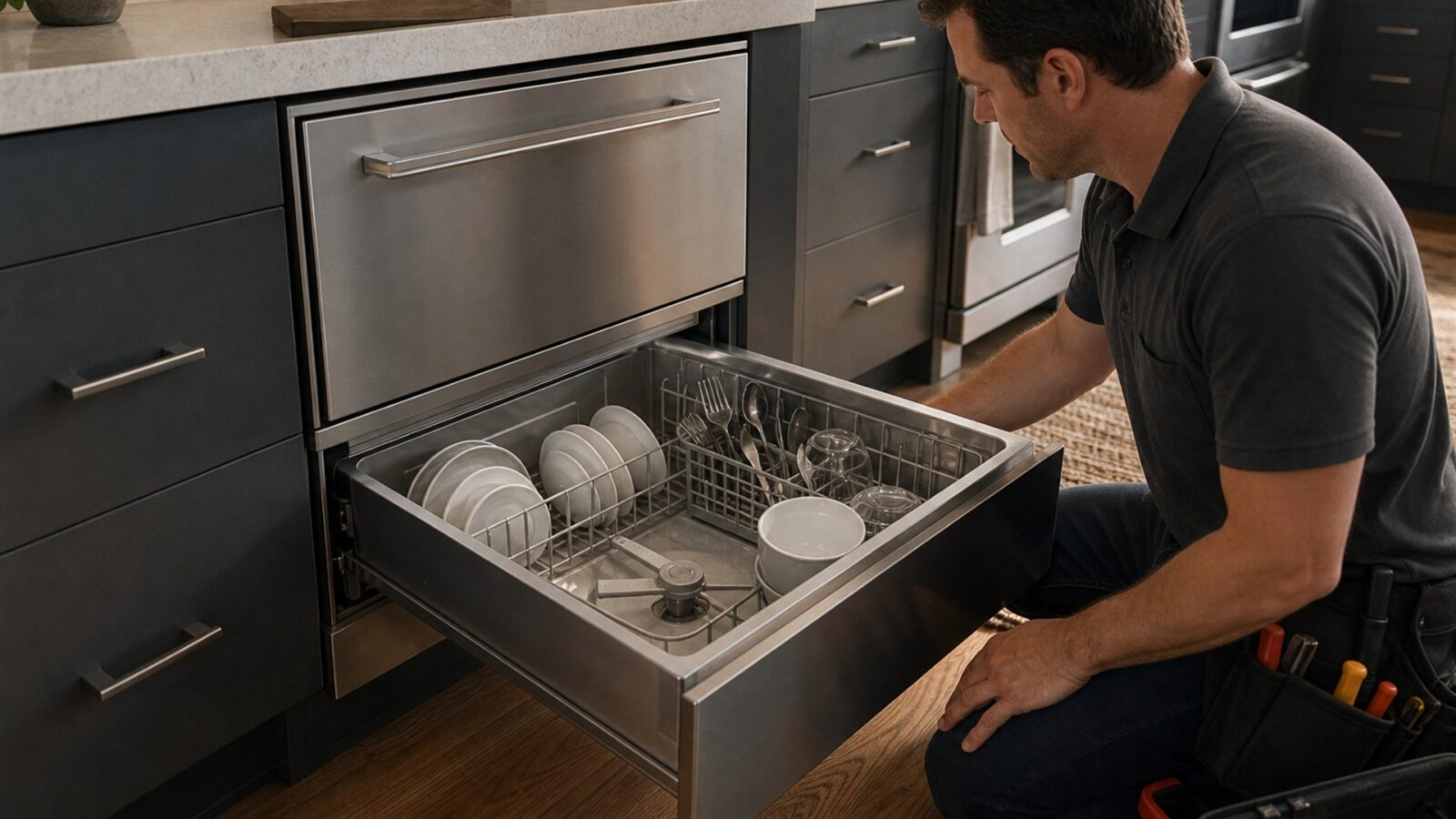
Specialized DCS Appliance Repair in Los Angeles and Orange County
If a DCS DishDrawer starts but does not fill, check the household water supply, inlet hose, pressure, and simple restrictions before testing valves or electronics.
A DishDrawer that does not fill is most often waiting on its water supply: a closed or partly closed shutoff valve, a kinked hose, or low pressure. Check those outside the machine first. If the supply is fine and the drawer still stays dry, the inlet valve or control needs testing.
If the control asks for water and too little arrives, the DishDrawer has nothing to wash with. Describe the problem precisely, because no fill, a very slow fill and a fill that comes and goes are three different symptoms.
While the unit is still running, put off any parts order. Check the basics you can verify without risk first, then let the symptoms that persist tell you whether professional testing is needed.
The household shutoff valve is closed or only partly open.
Low water pressure.
A kinked inlet hose.
A clogged inlet screen or other water passage, only where owners may service it.
A water inlet valve that is not opening normally.
A control or wiring issue.
| Symptom | What it can point to | What you can check |
|---|---|---|
| Nothing happens and no water sound | A closed supply valve or a kinked hose | Open the shutoff valve fully and look along the visible hose |
| Water arrives slowly | Low pressure or a restriction in the supply | Compare with the sink faucet and check for a pinched hose |
| A buzz or hum with no water | An inlet valve that is not opening | Stop and arrange service rather than testing the valve |
| U1 on the panel | A no-water-supply report on Classic-style displays | Confirm the water is on, then see whether the code returns |
Make sure the shutoff valve that feeds the dishwasher is open all the way, and that the supply hose has no kinks.
Confirm the household water valve feeding the dishwasher is fully open.
Check the visible inlet hose for a kink or pinch.
Listen for whether the appliance attempts to fill.
Look for U1, A1, or another model-specific water-supply message.
Leave a powered water valve in place and keep pressurized plumbing connected unless you are qualified to work on it.
Do not pry off live panels, work around safety switches, change gas parts, or go on running an appliance that leaks, overheats, trips a breaker again and again, or smells of gas.
With no fill at all, the cause could sit in the supply, a valve, the wiring or the control. A slow fill leans toward low pressure or a restriction, although a weakened valve can behave the same way. Take note of whether it came on suddenly or crept up over time.
The guide for Classic-style DishDrawer displays lists U1 as no water supply on. That is a statement about what the control sees, so it points you toward the household side first: the shutoff valve, the hose and the pressure at the house. A code that stays after those are confirmed shifts attention to the drawer’s own inlet components.
The same guide lists U6 as the spray arm coming loose or water pressure being too low. If you see low-pressure behavior along with slow filling, that overlap is a reason to look at the supply rather than the spray arm alone. A dry-sounding drawer after long idle periods is a separate matter, covered next.
The guide also advises pouring about three cups of water into the drawer before a program on first use or after a long idle period, because the motor area may be dry. That is a startup step in the manual, not a repair for a drawer that never fills.
A single restart on purpose may help when the electronics seem stuck or the trouble followed a short power interruption. Go through the normal disconnect, power button or breaker, and only if the user guide allows.
Restarting does not correct a lasting fault in the moving parts, plumbing, gas side, heating, refrigeration, sensors, wiring or controls. If the symptom returns after the drawer is back to normal use, repeated power cycles mostly slow down the diagnosis.
Book service if you hear the inlet valve buzz and no water comes in, if a connection drips, or if the same fill code keeps coming back.
Owner troubleshooting ends where the checks stop being meant for users. Cleaning, settings, loading, vents, visible hoses and cookware are fine. Opening the unit to test electrical parts, measuring gas pressure, touching a sealed refrigeration circuit or repairing anything under power requires training and proper equipment.
Many fill problems begin upstream of the appliance. A valve that is only partly open or a hose bent behind the cabinet behaves exactly like a faulty part. If you find a problem in the household plumbing, it is a plumbing issue and may need a plumber rather than appliance service.
Once the supply is confirmed good and the drawer still does not fill, further testing involves water and electrical connections together, which is the line where owner checks end.
When the basic checks do not alter the symptom, a technician can test the dishdrawer’s relevant components while they run, rather than replacing parts and hoping. Gather the complete DCS model number, serial number, any code or light pattern shown, and a brief description of when the problem happens before you call. That detail helps identify the correct product generation and diagnostic procedure.
Diagnosis by a professional matters most when the symptom is intermittent. Service information for the exact model, measurements at the components and stored diagnostic information go further than anything you can see from outside.
DCS Error Codes
DCS DishDrawer Repair
DCS Appliance Repair
DCS Model Number Guide
Related symptom and maintenance articles for this appliance family
On supported DishDrawer generations, U1 is associated with a water-fill or no-water condition.
Yes. The appliance must receive adequate water within the expected time.
Only follow user-service procedures listed for your exact model. Internal valve testing involves water and electrical connections.
Share a few details and we’ll confirm an appointment. Prefer to talk? Call us and we’ll help right away.
Fields marked with * are required.