

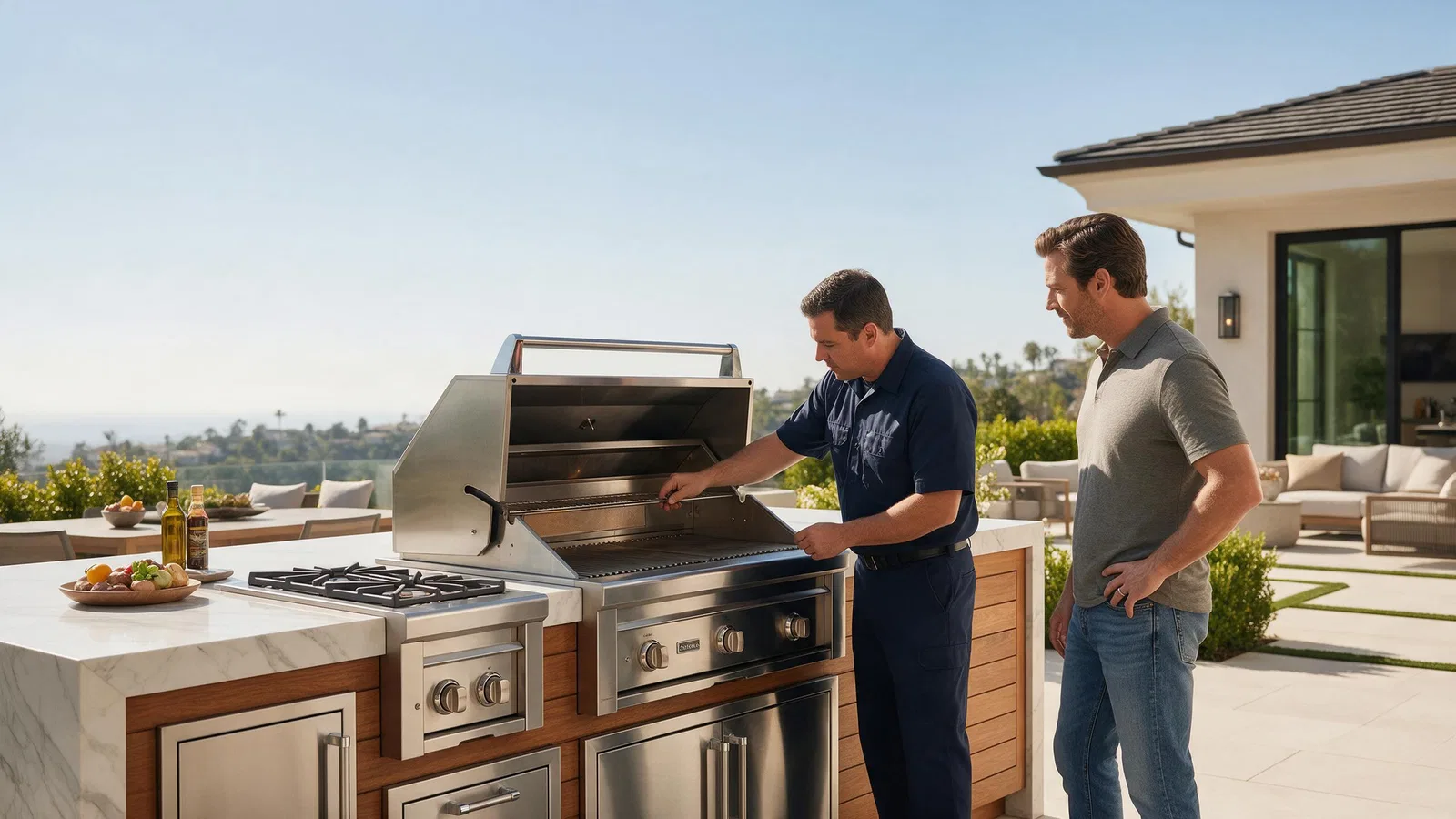
Specialized DCS Appliance Repair in Los Angeles and Orange County
A DCS grill that will not ignite may have no spark, no gas flow, dirty igniters, incorrectly seated burner parts, or an ignition-system issue.
If a DCS grill will not light, first separate no spark from spark without flame. With no spark, the guide for one DCS grill model points to the ignition battery, and with spark but no flame the first checks are that the gas is on and the burner inlet is clear. If you smell gas, do not keep trying to light it.
Sort ignition trouble into two groups first: no spark at all, and spark with no flame. Splitting it this way keeps the checking safer and a lot quicker.
As long as the grill still runs in some fashion, hold off on buying replacement parts. Work through the easy, safe checks first; the symptoms that are left will tell you if a professional needs to test it.
A depleted ignition battery on models that use one.
Dirty or contaminated igniter tips.
Moisture or residue around the ignition area.
Burner ports or inlets restricted by debris or insects.
Gas supply is off, empty, restricted, or incorrect.
An ignition module, switch, electrode, wiring, or gas-control issue.
| Symptom | What it can point to | What you can safely check |
|---|---|---|
| No spark at any burner | A weak ignition battery or a dirty igniter tip | Check the battery and watch the igniter tip for a spark |
| Spark visible but no flame | Gas off, an empty propane cylinder or a blocked burner inlet | Confirm the gas is on and look for webs when cool |
| One burner will not light while others do | Debris at that burner or its igniter tip | Clean the tip and burner area once cool |
Turn all controls off and let any unburned gas disperse before trying again. If you smell gas, do not keep trying to light it.
Turn all controls off and allow any unburned gas to disperse.
Check that gas is actually reaching the grill and that the shutoff valve is open.
On a model with an ignition battery, look at the battery’s charge and make sure it is seated the right way round.
Once the grill has cooled, clean the igniter tips and burner areas you can reach, following DCS guidance.
Observe whether you hear/see a spark before making further decisions.
Never take off panels that carry power, defeat a safety switch, or tamper with gas components. If the grill leaks, overheats, trips the breaker over and over, or leaves a lingering gas smell, quit using it.
When there is no spark, look at the battery, the button or switch, the electrode, the wiring and the ignition module. A strong spark without a flame moves the focus to gas supply, how clean the burner is, gas flow and where the spark lands.
The use-and-care guide for one DCS professional grill describes battery-powered spark ignition. It says to check the spark ignition and replace the battery at least once a year, and that the battery pulls out of the valve area after removing the drip pan. For lighting, it says to open the hood first, turn all knobs off and turn the main gas on slowly.
The same guide adds a five-minute pause before you try relighting a grill that is still hot.
On that grill, a side burner is lit by pushing and holding the ignition button while turning the knob to HI until it lights or four seconds pass. If it does not ignite, wait five minutes for gas to clear and try again, and never run a side burner without its cap.
The infrared rotisserie burner has its own sequence: hold the ignition button, turn to HI and hold the safety valve button until lit. If it does not light in four to five seconds, release it, turn the knob off and wait five minutes. The safety valve only passes gas while its button is held and its thermocouple is warm, so releasing the button too early can end the flame.
Restarting once, on purpose, makes sense when the electronics look hung or the issue started after a short power loss. Turn it off through the normal switch, button or breaker only if the grill’s user guide says that is acceptable.
Power cycling is not a cure for a repeating mechanical, gas, water, heating, refrigeration, sensor, wiring or electronic fault. When the same symptom comes back after the grill seems fine, more restarts tend to hold up the diagnosis instead of resolving anything.
If you smell gas and the burner won’t light, quit trying to ignite it. A gas odor that hangs around calls for gas-safety steps rather than more troubleshooting.
At home, stay with the jobs meant for owners, such as cleaning, settings, loading, ventilation, visible hoses and cookware. Testing electrical parts internally, working on gas pressure, servicing sealed refrigeration systems and repairing powered mechanisms need trained people with the right equipment.
If the simple checks change nothing, a technician can put the grill’s ignition and gas components through a test under working conditions, which beats replacing parts and hoping. Have the DCS model number in full and the serial number on hand when you call, along with any code or light pattern and a short account of when the grill fails to light. That detail tells the technician which product generation and which diagnostic procedure apply.
Professional diagnosis is most valuable for on-again, off-again ignition. A technician can draw on service data written for the specific model, readings taken at the components and stored diagnostic records, none of which a visual inspection reveals.
DCS Error Codes
DCS Grill Repair
DCS Appliance Repair
DCS Model Number Guide
Related symptom and maintenance articles for this appliance family
The igniter may be sparking normally while gas is not reaching the ignition point correctly or the burner is restricted.
Some DCS grill ignition systems use a battery. Check the exact model guide.
Yes. DCS specifically notes burner inlet obstructions, including spider webs, as a condition to check on applicable grills.
Share a few details and we’ll confirm an appointment. Prefer to talk? Call us and we’ll help right away.
Fields marked with * are required.