

Specialized DCS Appliance Repair in Los Angeles and Orange County
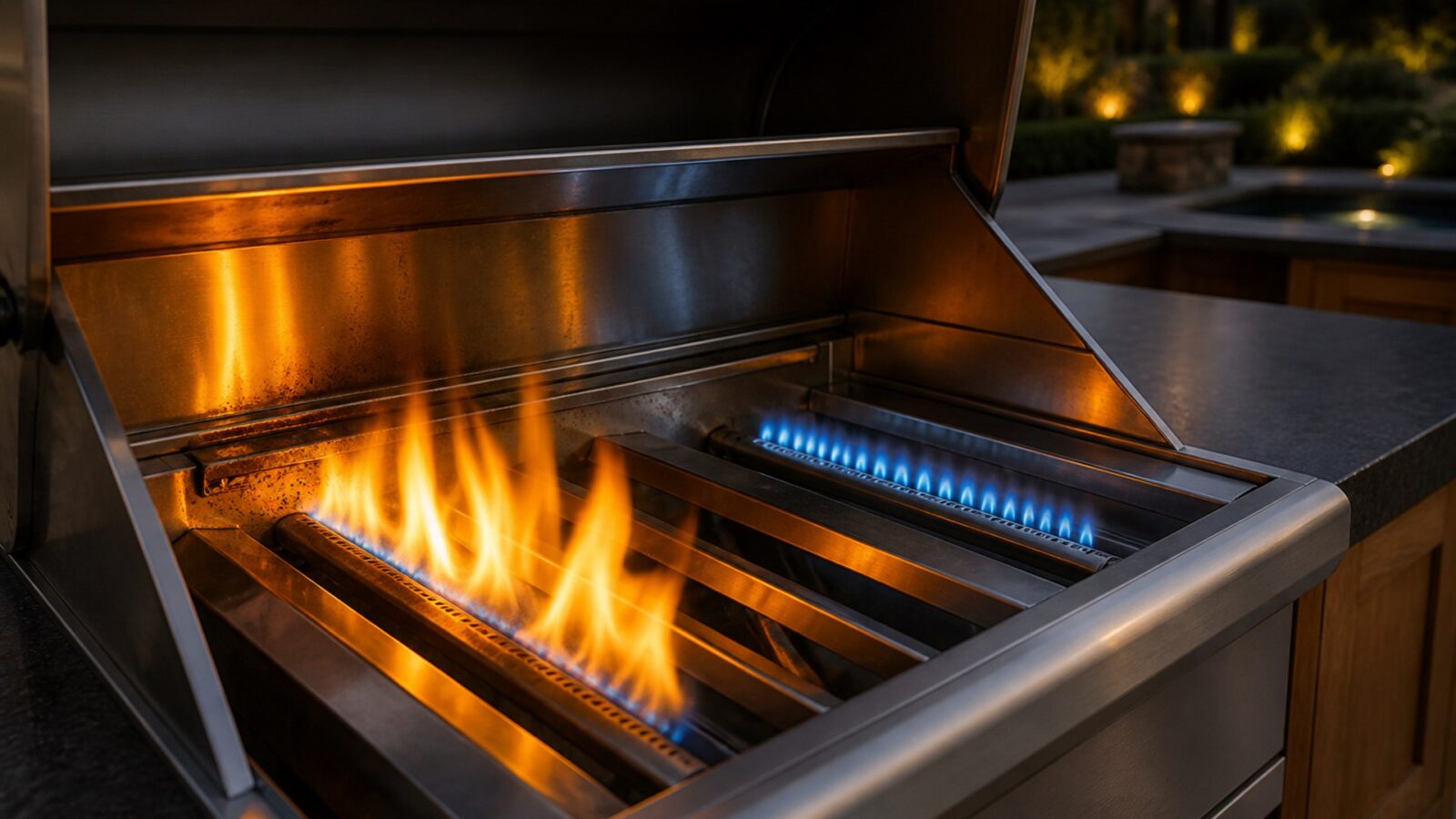
A persistent yellow or orange flame combined with gas odor can indicate poor combustion, blocked air or burner inlets, or gas setup problems. Treat a continuing gas smell as a safety issue.
A yellow or orange flame together with a gas smell means stop cooking. Turn every knob off, and if the odor stays with the controls off, shut the gas off if it is safe to do so, leave the area and follow local gas-emergency steps. If the smell clears, the first things to inspect once the grill is cool are the burner inlet and ports for spider webs or debris.
Flames can briefly change color from food residue, salt or airborne contamination. A yellow or orange flame that stays, paired with a gas smell, calls for more care, since the burner may not be blending gas with air properly.
When the grill still operates, skip the guess about which part to swap. Cover the simple checks that are safe for an owner first, and treat any symptom that survives them as a sign that professional testing may follow.
Burner inlet restricted by debris or spider webs.
Air shutter is not adjusted correctly.
Burner ports are dirty or partially blocked.
Burner is not seated or installed correctly.
Gas pressure or gas-type setup is incorrect.
A burner or gas-control component is damaged.
| Symptom | What it can point to | What you can safely check |
|---|---|---|
| Yellow flame, no gas smell | Too little air reaching the burner, or blocked ports or inlet | Once cool, look for webs, debris and dirty ports |
| Some yellow tipping on a propane grill | The guide for one DCS grill model says LPG units may show some yellow tipping | Compare with the flame description in your own guide |
| Noisy flame that lifts away from the burner | Too much air, which is the opposite of a yellow flame | Do not treat it as the same fault; note it for service |
| Orange flame with a gas odor | A blocked inlet or an air shutter setting problem | Shut controls off, let the odor clear and do not relight repeatedly |
| Every burner looks wrong at once | Gas type or setup rather than one dirty burner | Mention the pattern when you book |
Turn the grill off and stop cooking. If the odor stays with the controls off, shut off the gas if it is safe and leave the area.
Turn the grill off if you smell unburned gas.
When the grill has cooled, look over and clean the burner inlets and ports you can get to, following DCS guidance.
Check for obvious debris, insect nests, or corrosion.
Leave gas pressure and air shutters alone unless your model’s guide hands that job to a qualified installer.
Test again only after the gas smell has completely gone and the grill is safe to use.
Panels with live power stay on, safety switches stay active, and gas components stay unmodified. Continuing to run an appliance that leaks, overheats, repeatedly trips its breaker or smells persistently of gas is not an option.
No. A yellow flame alone can come from food residue or contamination, but a gas odor means unburned fuel may be present, so stop cooking.
A brief flame color change can come from contaminants. A gas smell is another matter: unburned fuel may be present, so stop cooking and deal with safety before anything else.
The use-and-care guide for one DCS professional grill describes a healthy burner flame as blue and stable, without yellow tips, excessive noise or lifting. In that guide a yellow flame means too little air and a noisy flame that lifts away from the burner means too much air, which is why the two look so different.
The same guide describes correcting the air shutter by removing the grates, grease shields and radiants, lifting out the burner and adjusting a lock screw. That is a hands-on gas-side procedure, so follow your own guide closely and leave it to a qualified installer if there is any doubt.
The guide explains that spiders and insects can nest in burners and block gas flow. Gas can then escape toward the control panel and burn behind the valve panel, which it calls a flashback fire. It recommends inspecting for webs and nests at the start of the season and after several weeks of non-use, and it suggests moving a grill out of a dusty area.
Try one planned restart when a control looks frozen or the symptom showed up after a momentary power cut. The user guide has to allow it, and the method is the ordinary disconnect, power button or breaker.
A restart will never correct a lasting mechanical, gas, water, heating, refrigeration, sensor, wiring or electronic fault. Should the same symptom reappear after operation returns to normal, extra power cycles are likelier to slow the diagnosis than to end the problem.
A gas smell that continues with every control off ends the troubleshooting. Close the gas supply if that can be done safely, step away from the grill, and follow your local gas-emergency procedure.
Do only the checks written for owners: cleaning, settings, ventilation, visible hoses, cookware and the like. Anything involving internal electrical testing, gas pressure, sealed refrigeration systems or powered mechanical repair needs appropriate training and equipment.
Where the basic checks do not alter the symptom, a technician can test the relevant grill parts under operating conditions rather than replacing them by guesswork. When scheduling, share the whole DCS model number and serial number, whatever code or light pattern appears, and a brief note on when the flame or gas smell shows up. With that, the correct product generation and diagnostic procedure are easier to identify.
Having the problem diagnosed professionally is especially sensible when it is intermittent. Service information specific to the model, measurements at individual components and stored diagnostic data are available to a technician but not to anyone just looking at the grill.
DCS Error Codes
DCS Grill Repair
DCS Appliance Repair
DCS Model Number Guide
Related symptom and maintenance articles for this appliance family
DCS grill burner cleaning/airflow guidance
Restricted burner air, blocked burner inlets/ports, burner condition, or setup can affect combustion.
Yes. DCS troubleshooting specifically calls out obstructions such as spider webs in the burner inlet.
Turn the controls off. If the odor persists, follow gas-emergency guidance and do not try to relight the grill.
Share a few details and we’ll confirm an appointment. Prefer to talk? Call us and we’ll help right away.
Fields marked with * are required.