

Specialized DCS Appliance Repair in Los Angeles and Orange County
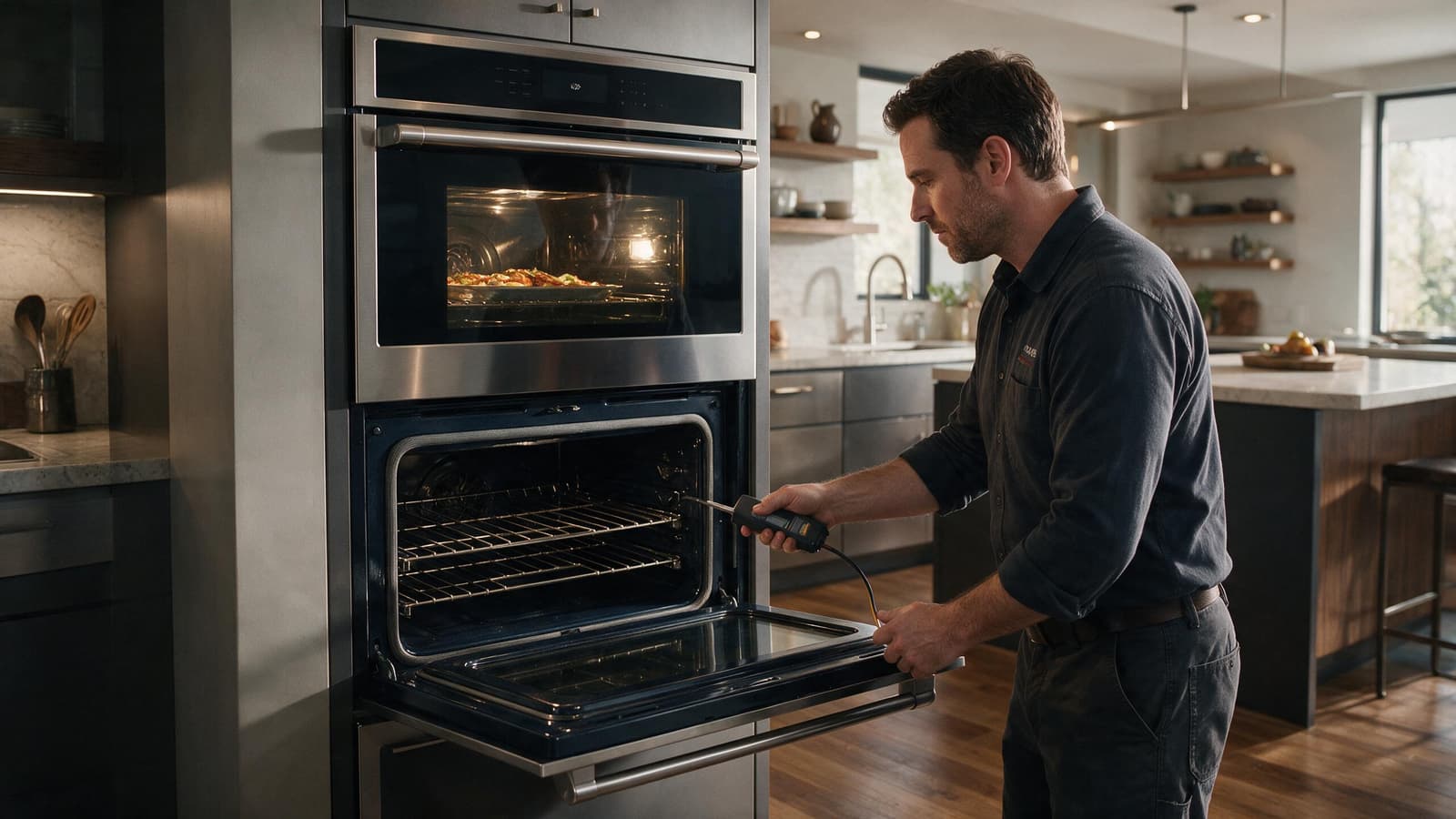
If the oven lights or knob halos work but the DCS range oven will not start heating, control power is present but the heating or ignition path may still be interrupted.
When the oven lights work but the oven never heats, the guide for one DCS range model points to the circuit breaker, the gas supply and a closed door first, and to Demo Mode as a setting to rule out. If those do not change anything, the heating circuit, a protective device or the control needs testing. Do not keep resetting a breaker that trips.
A familiar pattern with these ranges: the oven light comes on and some knob indicators glow, but the main oven never heats. That limits the possibilities without pointing at one certain part.
The range is still running, so there is no need to jump to a replacement part. Rule out the easy, safe-to-verify causes first; what is left over tells you whether the problem calls for professional testing.
On some models, a thermal limiter or other protective device has opened.
A bake/broil selector switch or a temperature-control input fails to carry out the command.
An igniter or heating component is not operating.
A door/lock input is preventing heat.
A relay, control board, or wiring connection is open.
The heating circuit is not receiving the power it needs, even though the control lights keep working.
| Symptom | What it can point to | What you can safely check |
|---|---|---|
| Lights work, oven cold in Bake | A bake-specific component or a selector | Try Broil and see whether it heats |
| Lights work, no heat in any mode | The heating circuit or a protective device | Check the breaker once and look for a code |
| Display responds but nothing heats | Demo Mode or a setting | Check your manual for Demo Mode |
| No heat and the door looks misaligned | Heating is disabled while the door is open | Close the door fully |
| Gas oven, no heat, burners work | Gas supply to the oven, or an igniter issue | Confirm the gas supply, including bottled gas |
Not much. On many DCS ranges the lights and knob halos run on a separate low-power circuit, so they say little about the heating circuit.
Verify which lights or knob halos illuminate when Bake is selected. On many DCS ranges the oven lights and knob halos run on a separate low-power circuit, so they say little about the heating circuit.
Find out whether the Broil mode produces heat even though Bake does not, or whether neither mode does anything.
Note whether surface burners operate normally.
Look for a display code on electronic-control versions.
Look at the breaker one time, and do not keep resetting a circuit that trips.
Never pull energized panels, jumper a safety switch or tamper with gas parts. Stop using a range that leaks, runs too hot, trips its breaker again and again or keeps smelling of gas.
A protective limiter opens in response to an unsafe temperature. When one keeps opening on the same range, the repair needs to find out why that area got too hot, whether that is door alignment, airflow, control behavior or some other heat-management fault.
The use-and-care guide for one DCS professional range says heating elements are disabled while the oven door is open. A door that is not fully latched, or hinges that sit slightly off, can look like a dead oven when it is really a safety interlock behaving normally.
For an oven that is not heating while the controls work, that guide lists the circuit breaker, the gas supply and Demo Mode as the checks to make. On a bottled-gas range, an empty tank is part of the gas check, and it is a simple cause to rule out.
Try a restart once if the electronic control looks frozen or the issue started after the power blinked. Cut and restore power with the standard disconnect, power button or breaker, provided the user guide says that is acceptable.
A power reset cannot repair a lasting problem in the mechanical, gas, water, heating, cooling, sensor, wiring or electronic parts. Should the symptom come back once the range is running normally again, more cycling of the power just pushes the diagnosis further away.
Find the underlying cause before fitting another protective component if the oven overheated earlier, a replacement limiter opens again, the door does not close properly or you can see electrical damage.
Owner-level troubleshooting means cleaning, settings, loading, airflow, visible hoses, cookware and other checks aimed at users. Anything involving internal electrical testing, gas pressure, sealed refrigeration systems or powered mechanical repair requires the right training and tools.
If the basic checks make no difference, a technician can test the range oven’s components while they run, which is better than replacing parts by trial and error. When booking, pass along the complete DCS model and serial numbers, any displayed code or light pattern, and a short description of when the trouble appears. Those details narrow down the correct product generation and test procedure.
When the problem comes and goes, a professional diagnosis is especially worth it. Service information specific to the model, readings taken at the components and stored diagnostic data are all things a technician can use that a look at the outside cannot reveal.
DCS Error Codes
DCS Range Oven Repair
DCS Appliance Repair
DCS Model Number Guide
Related symptom and maintenance articles for this appliance family
Low-power lighting and controls can operate while the high-power heating or ignition circuit is interrupted.
On some designs, poor door closure can affect temperature and heat management. It is worth checking if the door is visibly misaligned.
It should be electrically tested and the reason for overheating should be addressed. Internal range work involves hazardous voltage and gas on some models.
Share a few details and we’ll confirm an appointment. Prefer to talk? Call us and we’ll help right away.
Fields marked with * are required.